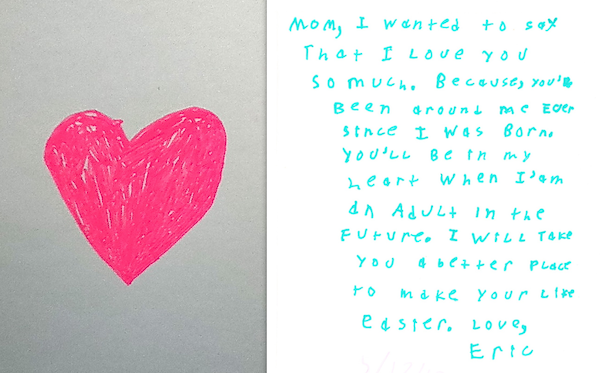
I never cry in front of Eric. I try to be cheerful and joke around with him a lot. I don't complain to him about "life." I don't ever want him to feel guilty about being autistic or requiring extra help from me. He doesn't need yet another thing to worry about. So to read the message in Eric's Mother's Day card yesterday was bitter sweet. Now I know that Eric knows things aren't always cheery with me and he wants to make things better for me one day.
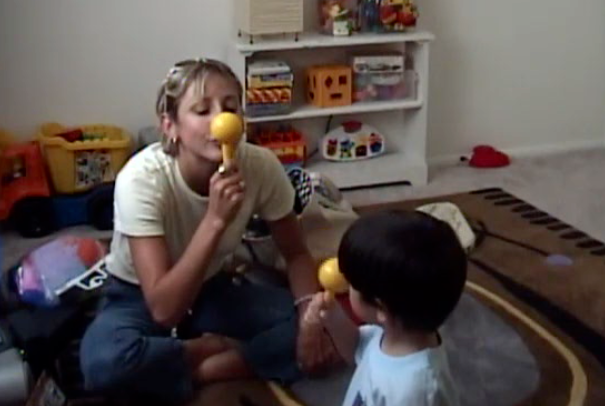
In this segment from Eric's music therapy session, we see some fairly common autism characteristics -- echolalia, some difficulty in maintaining focus and a bit of stimming (the stimming is something we never really discouraged, it seemed to help him burn off energy and regroup). We loved how the music therapist, Kim, kept the sessions fun and interactive and was always providing positive comments and feedback to Eric. Kim was working with Eric on some language goalssuch as:
• Request preferred object/activity with minimal prompts and/or using one descriptor (size, color, number) 2x per session 50% of sessions (i.e. "I want two shakers" or "I want yellow shakers").
• Respond to simple yes/no questions from the therapist using a complete sentence (i.e.: "Yes please", or "No thank you") with minimal prompts 2x per session 50% of sessions.
Music therapy in the videos I have posted so far may not seem like such a big deal --typical child's play you might say. But if you take a look at the evaluation for Eric (link at bottom), there is a lot more going on than first meets the eye. For example:
During the maraca play, he demonstrated the ability to keep a beat in time with the music for most of the song. He was able to play the castanet, which required finger isolation, however had some difficulty and required help holding the instrument. It was at this time that it was evident his right was his dominant hand since he was able to complete lhe task with this hand. This information led the music therapist to believe that both sides were equally developed.
If you are considering music therapy for your child, then this 5-page evaluation and recommendation for Eric’s therapy program is worth reading. It will give you a very good idea how music therapy works for children on the autism spectrum. Prepared by the therapist after three, one-on-one sessions, it goes into detail describing what was observed and proposing strategies in the following areas: Cognitive/social, communication/language, motor-skills, sensory, and behavioral.
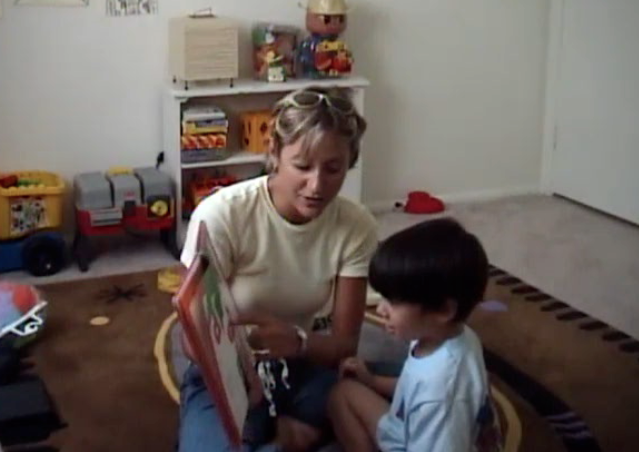
This is another segment of the same music therapy session described in the first post. They are using the book Chicka Chicka Boom Boom, by Bill Martin Jr. to practice the alphabet. Kim, the therapist, was very good at bringing Eric's attention back to the activity whenever his attention wandered.
Here is the first of a series of videos I will be posting over the next couple of weeks of Eric during music therapy. He is 4 yr. 5mos. in this video and was diagnosed about 7 months earlier. He communicates with one or two words and there is a lot of echolalia still. This is probably the third week of therapy. Typically 45 minutes long, 1-2 times per week. The first session is an evaluation to make recommendations and to create a program with measurable goals --similar to an IEP. Every 2 months we are given a progress report. I will post samples of those also at a later date. This video shows the opening "Hello" song and creating a visual schedule together. Some activities work on very specific academic skills like the alphabet or geometric shapes (again, I will be posting samples of those activities in the future). Other fun activities like dancing, focus on social skills such as staying on task and following directions.
The New Yorker published this article last week which brutally dismantles the whole notion of brain training as a way to improve intelligence. It references the same article from the New York Times that I had mentioned in anearlier post. Calling it typical of the current media hype surrounding brain training --the same article that motivated me to try it out on Eric. An experiment that left me feeling rather skeptical afterwards.
By Gareth Cook, The New Yorker Posted: April 5, 2013
Even though I have moved on, this is a very lucrative industry that won’t be going away that easily. The New Yorker said this of Cogmed, one of the first commercial brain training companies:
“Cogmed is operating in more than a thousand schools worldwide, more than a hundred of which are in the U.S. In January, Cogmed launched a major push into American schools, which it charges up to three hundred dollars per child.”
Eric was placed by the school district in program with other “high functioning” autistics. Meaning most of his classmates have Asperger’s and are pretty articulate. Some are incredibly knowledgeable and quite chatty about their areas of interest. Eric is not like that at all. He struggles with language, both expressive and receptive. But somehow Eric makes friends.
Eric has matured and improved to a point where I no longer need to facilitate socialization when he has a friend over. From snippets of overheard conversations and things Eric tells me directly, I now have a better understanding of what friendship is. It’s not about sharing things in common or having deep conversations. His friend loves chemistry, rockets, and things that blow up. Eric is not that into science but he is a willing listener, and tries to understand. He seems to enjoy the energy and cheerful excitement his friend has over his favorite topic. His friend does not pressure Eric to have an ongoing conversation. Ironically, Eric talks more when the pressure is off. His friend won’t judge him. And Eric would never say to his friend, “why can’t we talk about something else.” There is an understanding between them that it’s ok to relax and be yourself when you are with me. They are enjoying each others company and it’s not about the words exchanged. They are not in two separate worlds --they are together and there is a bond.
Arta new page chronicling Eric’s struggles, progress, and perseverance in this area.
Note: "NA" links are future links not available yet.
About This Blog
When Eric’s symptoms of autism were at their most severe, he was four years old, had very limited language, and eye-contact seemed painful. There were some unusual behaviors and reactions that would test our sanity, not because of the action itself, but because we were desperately trying to figure out what was going on in his brain. What was Eric thinking? What was he afraid of? Why was he doing that? He did not have the words to tell us then...
Permission to Fail
-
We've talked before about giving ourselves permission ...wait...have we
talked about this? Permission to be late, for example? Dammit. Lemme
look.
I......
Have a Break
-
When you’ve forgotten the password to update your own website you know it’s
been far too long… I read an article the other day that said we should stop
say...
Flying Away
-
I always have a nest or two of baby birds at my front door. I wait
expectantly each spring to see who my new neighbors might be. A robin or a
wren? Maybe...
How to Deal with the Fourth of July Aspie Style!
-
Like many aspies I hate loud noises and get over-stimulated by them. So,
as one can imagine American's Independence Day and I have never quite got
along. ...